
Click here to read ASAP's spring update.
 This depiction of What Makes a Good School was created in rural Zimbabwe. As part of the UNICEFSocial Awareness Campaign for Primary Schools project, ASAP Africa is proud to be included in a consortium of over 20 local organizations working together to answer this question.
 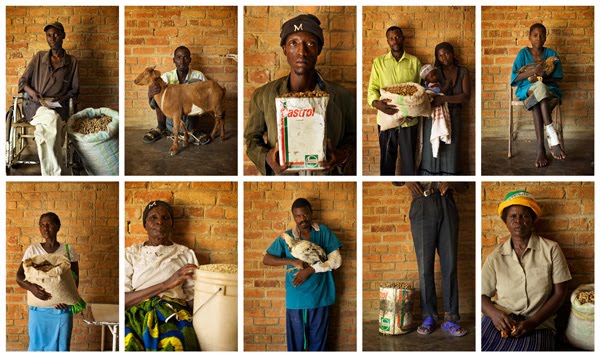 Not long ago, Zimbabwe was the breadbasket of Africa. Recently, the United Nations found Zimbabweans to be among the world’s poorest people, often making mere survival an all-consuming task.
  by Victor Katchika-Jere
 A team of four software development students, Charles Chen, Charles Naut, Derek Czajka and Sophia Westwood, from Stanford University will be making improvements on ASAP's website as part of the annual Stanford Hackathon this week-end. The talents of these students will help launch ASAP's new Light the Way campaign, making web site additions and improvements for 24 hours. To read more about the other Hackathon projects click here.
 The map above shows the prevalence of malnutrition in Zimbabwe in 2003. ASAP Africa works in the Eastern Nyanga and Chimanimani region, both areas on concern during the 2011 "lean season" between now and March. According to the FEWSNET - The Famine Early Warning System and Network - acute malnutrition may also be a problem. The fact that these historically very productive agriculture regions are now at-risk is a grave concern. To read more click here.
  Many in US are familiar with SIFE, Students in Free Enterprise but may not be aware of this groups tremendous global impact.Pictured here, in Mutasa District of Zimbabwe, ASAP Africa VS&L rural savings club members were oriented on financial intelligence by Africa University SIFE students. To learn more about VS&L click here.
  This Acacia tree growing in a groundnut field has been shown to provide more than just shade for a farmer in rural Malawi. Referred to as the "fertilizer tree" and "miracle tree" some species of acacia actually improve soil quality. Click here to read more. Faidherbia albida or the apple-ring acacia, is one acacia that has been shown to boost crop yields. In Zambia preliminary research has found that unfertilized maize yields in the vicinity of acacia trees averaged nearly three times those of crops grown nearby but beyond the trees' canopy.Click here to read more.


President Robert Mugabe has angered hardliners in his fractious party by supporting recommendations by his deputy, Joice Mujuru, to shelve the controversial indigenization law and set aside plans to hold elections this year as the succession issue heats up in Zanu PF, The Zimbabwe Standard reported.
Mujuru, who is battling against Mnangangwa to succeed the 86-year-old leader, made the recommendations before the party's Mutare conference last month following consultations with the business community. "The notion was strengthened further when Mujuru attended the swearing in of the Brazilian woman President, Dilma Rousseff last week," said the source.
The sources said Zanu PF hardliners and the Mnangagwa faction pushed for an early election before and during the party's conference last December.
Just before the conference Mugabe, who has ruled Zimbabwe for the past three decades, had vowed that elections would be held before June this year with or without the new constitution.
Although the Mutare conference then resolved to hold elections this year without fail, Mugabe later heeded Mujuru's advice after coming under immense pressure from South African President Jacob Zuma.
Zuma in his capacity as the Southern African Development Community (Sadc) mediator in Zimbabwe is demanding extensive reforms to enable free and fair elections to be held in the country following the inconclusive 2008 polls.
Mugabe made the unusual about-turn after meeting with Prime Minister Morgan Tsvangirai and his deputy Arthur Mutambara soon after the conference, telling the nation that elections would be held after the crafting of the new supreme law.
"When Zanu PF went to the conference, they had two main objectives: Early elections and pushing the indigenization agenda. But talk of both slackened after Mugabe listened to Mujuru's advice. Hardliners are furious that he dumped all they had agreed on in Mutare in favor of Mujuru's recommendations," said one source.
Government has since frozen the controversial indigenisation law after admitting that it is discouraging the badly-needed foreign investment and political observers last week said it was highly unlikely that polls would be held this year, especially with reports emerging that the new constitution can only be finalized later in the year.


There was joy and earth-shattering celebration at Mwanza Community Ground on 17 December 2010 when 78 women from nine Village Savings and Lending groups who have participating in ASAP Africa Malawi’s Chimvano pa Chuma Project were being presented with certificates.
“I can’t believe this is happening to me!” A visibly elated Mary Bintoni exclaimed. “I cannot believe my business is running well and I still have this envelope with more money than I contributed to my group’s savings!”
On this day, the women received their certificates acknowledging their successful completion of a savings and lending cycle, and an envelope containing money they had contributed to their group’s savings plus the interest it had accrued in the lending activities. ASAP Africa Malawi’s Country Director could not hide his satisfaction: “We are very pleased that we are meaningfully contributing to Malawi Government’s efforts to provide a means for rural women to become self-reliant”, he enthused. Over Mk 830, 000 was shared at the function.
“This festive season is a season with a difference. At a time like this last year, before I joined ASAP’s Chimvano pa Chuma Program, I was in extreme debt and had no food for my children. Now, I have all the money I need for my business, food and farm inputs,” said a jovial Mrs Kamwana.
 In Malawi ASAP begin has been encouraging farmers to grow Pigeon Peas since we began working in the country in January 2009. In partnership with Total Land Care, ASAP facilitated the distribution of superior Pigeon Pea seeds in a seed multiplication project. To learn more about ASAP Africa's agriculture projects - that YOUR donations make possible - click here.
 Due to economic and political hardships in Zimbabwe over the past 10 years, it is estimated that more than 3 million Zimbabweans are living outside of their country today. Thanks to the UK-based Development Foundation for Zimbabwe, diasporans in more than seven countries will meet later this month to dialogue with the Government on how they can inject millions of dollars in investment as part of actively participating in the economic recovery of the country.To read more click here. Plans for future investment are certainly encouraging. The map above depicts the the food insecurity prevailing in this country of desperate need. Your contribution to ASAP is helping families survive and thrive today.


 Aimed at raising agricultural output and counter climatic unpredictability, Malawi's “Greenbelt Initiative” will bring changes to the agriculture sector. Malawi, a country of 14 million people, one of the world’s most densely populated nations, is mainly dependent on rain-fed agriculture but recent climatic changes have affected its production.
Elizabeth Bara and Tom Arsenault have recently returned from visiting both the ASAP Malawi program and the ASAP Zimbabwe program. In Malawi, some days were spent meeting field officers in the rural areas where the projects are implemented. They were able to meet many of the Village Savings and Lending (VS&L) club members and hear firsthand about the various activities of the project.
One of the members is doing a great beekeeping project with ten beehives. Some are doing piggery, some fowl and eggs while others are cooking doughnuts and cakes. The majority of members are buying and reselling for their income generating projects. Buying and reselling involves quite an number of different products such as tomatoes, dried fish, clothing, flip-flop shoes, various nuts, vegetables and many others. There are even a couple of groups doing larger whole group projects – making and bottling achar (a type of relish) and fruit jam.
The Malawi program is relatively new and it is so exciting to see how these women have gone from zero to having their own money for school fees and farming inputs as a result of the training from ASAP field officers. And they all certainly expressed how happy and grateful they are for ASAP’s extensive training in VS&L.


